
Food Waste is a significant global issue with several interconnected problems: environmental impact, economic loss, hunger and food insecurity, ethical and social issues, resource depletion and food system inefficiencies.
The NRDC estimates that 40% of all food grown in United States is wasted. Food scraps represent 20-25% of the waste that is disposed as trash. Americans are throwing away over $218 billion worth of food each year. If food waste was a country, it would be the 3rd largest greenhouse gas emitting country in the world!
Landfills emit methane gas, one of the most powerful greenhouse gases and other air toxics emissions. Food waste contributes more methane emissions than other landfilled material because of its rapid degradation. From 1990-2020 methane emissions from landfilled food waste increased steadily by 295 percent. In 2020, landfilled food waste was responsible for emitting approximately 55mmt CO2e methane emissions based on a 100-year global warming potential. This is equivalent to the annual GHG emissions from 15 coal-fired power plants.
What’s Happening in New Jersey?
NJ is the 2nd most affluent state with four counties in the “Top 20” most affluent in the United States: Morris, Hunterdon, Somerset and Bergen. Despite this affluence, 11% of NJ’s population and 15% of children 18 years of age and younger are food insecure.
50×30 The NJ Food Waste Reduction Act of 2017 (N.J.S.A. 13:1E-226 et seq.) establishes a goal of reducing food waste generated annually by 50% by the year 2030, based on the amount of food waste generated in 2017 (50×30 Goal).
As per NRDC, food waste generators are:
-
43% Residential
-
26% Restaurants
-
14% Retail Supermarkets
-
9% Institutions (Hospitals, Prisons, Schools)
-
8% Food Manufacturers & Processors
The 2023 NJDEP Food Waste Reduction Plan outlines three major categories:
-
Food Waste Reduction
-
Food Recovery
-
Food Waste Recycling
Building on the 2017 Act, Governor Murphy signed a new law (S2426/A2090) in January 2026 that requires every solid waste management district in all counties to develop a formal food waste reduction plan. The law sets a new target: a 50% reduction in food waste by 2035, measured against 2022 levels, and gives districts two years to implement their strategies once the law takes effect. The law also directs NJDEP to establish a tiered regulatory structure for compost facilities, easing long standing permitting and zoning barriers that have made it difficult to open food waste and composting operations — with smaller-scale exemptions for schools and community gardens.
Food Waste Reduction
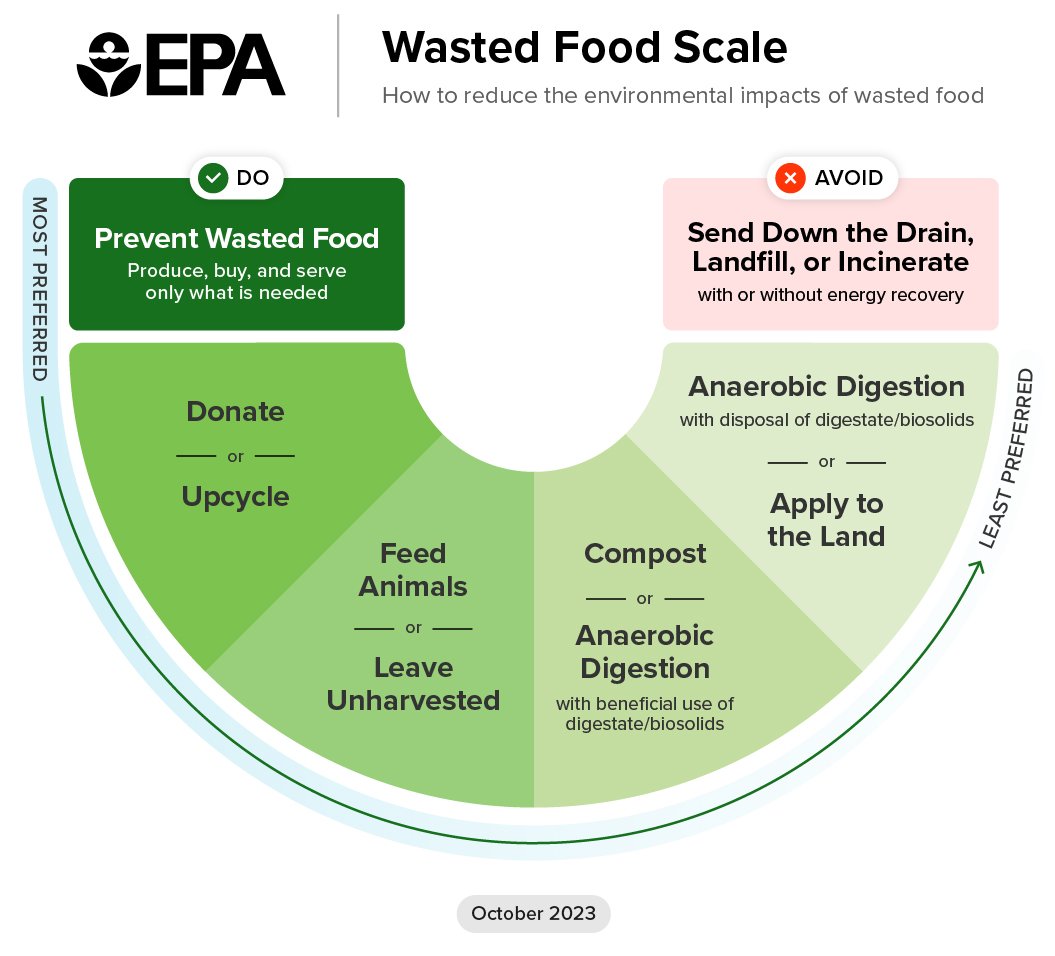
Produce, buy and serve only what’s needed! Make sure to check your fridge and pantry before food shopping.
Date label terms such as “sell by”, “best buy”, “use by” are confusing. Food manufactures use them to an approximation based on food quality and color retention. NJ law only requires dairy products and shellfish to display a date label on the product. Federally, only infant formula requires a “Use-By” date label.
Food Recovery
Currently, there is a disconnect between food recovery and donation. There are many people/businesses/restaurants interested in making donations but not sure where and how to start. And many people that are food insecure have to make tough choices daily. Parents skip meals, so they can feed their children, seniors choose between buying medicine and food, and students decide between education and food.
The Good Samaritan Donation Act protects donors from liability from ordinary negligence. So, before throwing away food, consider if it can be donated through the various networks of food banks, food pantries and soup kitchens.
Start share tables at schools, cafeterias and places of worship.
Encourage food rescue apps such as “Too Good To Go” where customers are connected with restaurants and stores that have surplus unsold food.
Other options for food recovery are to feed animals and upcycle.
Food Waste Recycling
Food waste is rich in nutrients and when properly composted, it become a rich soil amendment. Composting sectors can be broken down into residential, municipal, schools and commercial.
-
Curbside – contract with a private hauler
-
Backyard or Community Garden
-
Inside small scale using black soldier flies, worms, dehydrators, etc.
-
Join a municipal program
Municipal composting options are anaerobic (waste – to energy) or agricultural/farm (compost). Key steps to starting a municipal program are:
-
Identify Champion on the Township Council
-
Identify how the town want to reduce waste? (waste to energy or composting)
-
Conduct survey with educational material to residents (Why the need to compost? What are you willing to do? How much are you willing to pay?)
-
Township budget (Staff time, Compost Bins, RFP for Haulers)
-
Drop Off Locations (Convenience Center Exemption, Industrial facilities, Agriculture/Farm)
-
Perform a pilot program
Resources: